Dabitch.net - Everything is so random there must be a pattern

Hi, I'm Åsk, I'm a geeky creative director. Here I share whatever is on my mind and the occasional script.

Dabitch.net - Everything is so random there must be a pattern

"If she's crying, she's buying" Brand Equity, India 2016

"If she's crying, she's buying" Brand Equity, India 2016

Brand Equity, India, did an excellent digging on the topic of Femvertising in: If she's crying, she's buying: Are brands manipulating female consumers?, interviewing plenty of ad professionals, myself as a representative of Adland included. (archive link)
 

So, what's wrong with riding the Femvertising bandwagon?

There's nothing wrong with hopping on the Crisis du jour Express. Except that if there's no brand connect or intent to sustain the message beyond the ad, it ends up mocking the idea of women empowerment first, and denuding the brand image eventually. While the likes of Anouk are yet to prove how well femvertising can work, brands like Skore aren't able to score positive points for progressive display of women because of shabby execution.

Where they plan to go via the femvertising route is a question brands ought to ask of themselves. As Åsk Wäppling (aka Dabitch), founder of ad portal adland. tv, points out: 'Will keep you dry' is a promise a sanitary napkins brand can keep. 'Will let you win the Olympics because you're a powerful woman,' is not. Aspirational is one thing, but promising societal changes due to product use is not right — unless the brand is into fair trade, water saving, donating to research, planting trees or otherwise actively doing something other than making advertising. Not to mention how most of these ads are only high on plot recall and not brand recall, as is evident from Mrs. Sharma's list.

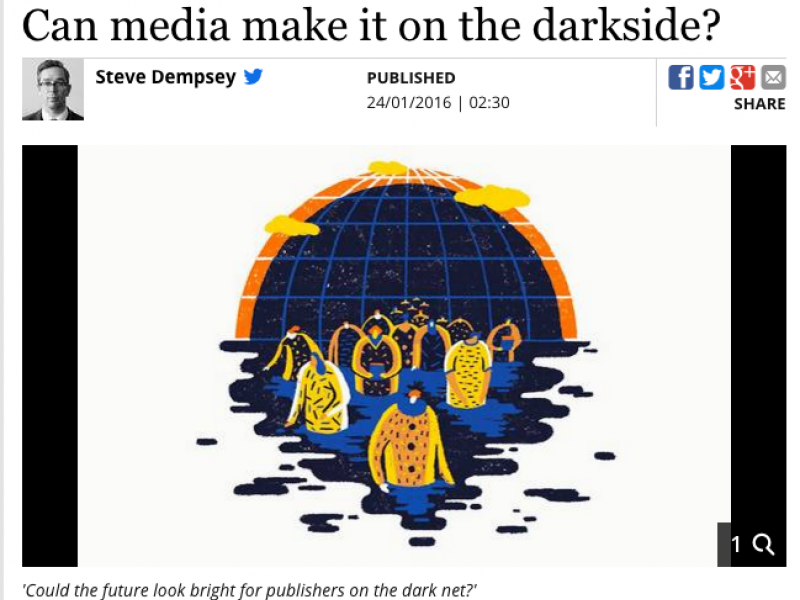
Independent.ie "Can media make it on the darkside?"

Independent.ie "Can media make it on the darkside?"
Can media make it on the darkside?" asks a headlne at Independent (Ireland) that looks at media that venture out on the Dark web, and why they do. (archive link

Adland is the other website to go over to the dark side. It's a site dedicated to showcasing advertising creativity. Founder Åsk Wäppling told Drum Magazine that the decision to set up on the dark net was based on an increase in the number of visitors to her site using ad-blocking software.

She believes that privacy is now a pressing issue for her audience; they don't just want to block the ads, they want to block the data that's being gathered on them. Yes, you're right: it's more than a touch ironic that the audience for an advertising site is turned off by the ads and ad-tech on the standard version of the site.

The Drum: Adland goes Dark (web)

The Drum: Adland goes Dark (web)

The Article "Adland goes dark (web)" is a short but sweet interview with me about ad banners, Tor, trackers and all the other fun stuff that has nestled into every device you have. (archive link). Here's some choice bits from the interview. 

Founded twenty years ago, (“Adland’s almost old enough to buy himself a drink”) and one of the top destinations for Super Bowl creative, Wäppling made the decision to put a version on Tor from some practical data after Apple iOS made ad blocking available on mobile phones and tablets.

“As soon as that happened, ad blocking went up from ten percent to sixty five percent on Adland,” said Wäppling. “And it’s not just the fact that I attract a different crowd — a gamer crowd that’s more technical — it’s because the industry creative Apple fan boys have easy access to ad blockers, and they’re using them.”

Seeing the uptick in ad blocking made Wäppling understand that issues around privacy had become more acute.

------

A long time user of Tor, the decision to add a version of the site was on Wäppling’s mind for a long time, but moving forward was sparked through a Twitter interaction on whether or not the dark web was responsive design and some nudging from a colleague.

“(A colleague) dared me to do it. I did it in under ten minutes. Boom. There it was. And I decided to announce it.”

Shortly after the announcement on LinkedIn, Wäppling realized that she had entered the dark web only hours after the independent, nonprofit investigative journalism site, ProPublica.

"Seeing that ProPublica did the same just hours earlier shows that the time is ripe for more news publications to enter the dark web,” said Wäppling. “I wouldn't be surprised if this became a trend, but you're not likely to find the CNN's or BBC's on the dark web anytime soon."

Dagens Media: Reklamtrötta reklamproffs ledde till sajt på dark web

Dagens Media: Reklamtrötta reklamproffs ledde till sajt på dark web

Dagens Media in Sweden writes about our travels to the Dark Web: "Reklamsajten Adland har startat en version av sajten på dark web där det är lättare att surfa anonymt." (archive link)


When Apple introduced the opportunity to block advertising on the iPhone, Adland CEO Åsk Wäppling noticed a radical change. The proportion of visitors using ad blockers increased to 65 percent.

As a result, last week she launched a version of the site on the dark web for those users who want to surf completely anonymously. It took her about five minutes to post the site which made her the second major publicist after ProPublica on the dark web. The site has so far had about 3040 visitors.

The important thing is not how many people visit the site without the opportunity, she says.

For her visitors, who largely consist of people in the advertising industry, it's not just about avoiding visible banners. More and more people use ad blockers and other software to avoid malicious code and to ensure that even personal data is not stored and disseminated.

No wonder more people now want to take control of their data. I have been warning about this for over ten years. If the advertising networks had not been so customer-oriented, we probably would not have had these problems with Adblockers now, she says.

According to Åsk Wäppling, ad networks are soon impossible to distinguish from spyware and malicious code.

They have distorted .js, hidden iframes, many redirects, invasive tracking, suspect top-level domains, and save personal data in URLs.

Website as hidden service: how do?

Website as hidden service: how do?

Was talking to a pal about ssh as hidden service. “It’s simple” he said, and practically dared me to do it. But I didn’t really want ssh, I thought let's do http instead because Adland. Oh okay. So you want to try it too? Lets go.

sudo apt-get install tor

Simple, right?

sudo nano /etc/tor/torrc to add the following

HiddenServiceDir /var/lib/tor/ssh_hidden_service/
HiddenServicePort 80 127.0.0.1:80

Now, that’s port 80. Do 22 if you want to cloak your ssh.

now: service tor reload

and check what your hostname is:

sudo cat /var/lib/tor/ssh_hidden_service/hostname

Now that you know your name, you’ll have to add a SERVERALIAS in your apache conf somewhere, wherever you keep that stuff. Could be apache.conf, or in apache2/conf-enabled/000-default.conf or even in your .htaccess depending on how homey play dat. Reload apache after adding the serveralias.

ta-dah, you’re done.

So anyway, that’s how Adland became available on the dark web, the world’s first ad news source to be accessible as a Tor hidden service

My friend also made a post, but in Swedish: “SSH som hidden service

Permission denied (publickey) on AWS instance Ubuntu

Permission denied (publickey) on AWS instance Ubuntu

So, you were minding your own business chmodding things left and right while logged in to your Ubuntu instance the other day, and now a few days later you get the Permission denied (publickey) response when you try to log in.

Even if you do sudo ssh -v -i YOUR-KEY.pem ubuntu@YOUR-IP, all the verbose flag tells you is that the key is denied. Hmmmm.

Have a think, did you change the permissions of the ubuntu home directory? You did? Oh, well that was the problem then, Ubuntu does not like having the home directory of Ubuntu changed so Ubuntu will not let you log in now. Ooopsie!

What next? You have a dead instance, well, dead in the sense that you can not ssh in to it. No worries, follow these steps:

Log in to your aws console. Stop your broken instance and detach the EBS volume that is the root volume of this instance (this is a good reason to name all volumes, but you can easily find which instance the volume is attached to by looking at the description). wait for it to come to a complete stop.

Start another instance, a temporary one, or if you have one already prepared. You will attach the root volume from your broken instance to this one. Make sure it’s in the same availability zone! us-east-1b and us-east-1d are not the same thing, yo!

Now attach the broken root volume to the new temp instance, like at /dev/sdf
NOTE: Newer kernels are gonna name the partition whatever the hell it wants anyway, so sudo sfdisk -l to find it. It might be /dev/xvdf but lets assume here that it’s /dev/sdf

ssh [your temporary instance]
sudo mkdir -m 000 /vol-a
sudo mount /dev/sdf /vol-a

Voila! You now have your root partition mounted, so head to the /home/ubuntu and set correct permissions. It should be drwxr-xr-x but just to make it simple do chmod 755. While you’re at it, add another user that can log in, just in case.

Nononono, not with the adduser command, silly wabbit, you’re not running this EBS volume right now. You have to get your hands dirty and edit some files in /etc cd /vol-a/etc. You can break some shit by manually editing /etc/passwd, /etc/shadow, /etc/group or /etc/gshadow but hey, we’re living on the edge here. Look at these files, if you don’t know what you’re doing, leave them the fuck alone. Otherwise a line like dabitch:x:1001:1001::/home/dabitch:/bin/bash works well in /passwd.
dabitch:!:: in gpasswd , dabitch:x:1001: in group, in gshadow add dabitch:!::. The /shadow file has the following structure:

Username : Password (encrypted) : Last password change (lastchanged in days) :Minimum # of days password can be unchanged : Maximum# of days password is valid: Warn # of days before warning about password change : Inactive # of days after the password expires that the account is disabled :

Now that you know all that, and you’re using a .pem file with your instance anyway, wing it! dabitch:!:16805:0:99999:7:::

Don’t forget to mkdir /home/dabitch or whatever user name you chose because you are not dabitch, I am. Arity, now …

sudo umount /vol-a
sudo rmdir /vol-a

If you get a “device is busy” it’s because you’re in vol-a, cd / first.

Shut down this temp instance and attach the EBS to your previous instance again. Remember, it’s /dev/sda1 on your instance, that’s where the root partition goes.

Now start your previous broken instance and check if you can’t log in this time. You can! Well, there you go. Now don’t do silly things like changing the /home permissions on Ubuntu again, silly wabbit.

Mediabistro: 8 Blogs Every Media Professional Should Follow

Mediabistro: 8 Blogs Every Media Professional Should Follow

Mediabistro published this article called 8 Blogs Every Media Professional Should Follow (web archive here), and my website Adland was one of them. Quote:  
 

Adland

Åsk Wäppling created Adland in 1996, ancient times when it comes to the Internet, but this blog is no relic. By establishing herself early on, Wäppling cemented Adland’s reputation as an authority/clearinghouse on all things advertising, from print to digital to television campaigns. The content of Adland’s posts show a similar breadth, touching on issues impacting the profession as well showcasing its creations.

Tom Megginson: "Who owns Adland?"

Tom Megginson: "Who owns Adland?"

Tom Megginson, who writes the adblog formerly known as "Work matters" and now rebranded to "The Ethical Adman", noted the Adland-trademark fight. "Who owns Adland?" he asks in this May 2015 post (archive here). 
 

Adland is absolutely ancient in internet terms, having been established in 1996 when most ad people were still trying to figure out if the web was good for anything except free shock porn. A young Ms. Wäppling, under the pseudonym "Dabitch," instead saw the opportunity to create an online global ad archive and professional forum, which in this decade Brand RepublicBusiness Insider, and Fast Company have listed as one of the most influential in the industry. She even trademarked the name, several years ago. And he's been a mentor as I've fumbled my way into the ad blogosphere.

So you'd think it would be pretty clear that "Adland" = adland.tv. Especially among ad industry bloggers.

Apparently not. As you can see from the Google screencap above, venerable industry magazine Ad Age uses the term "adland," in a generic sense, to refer to the industry in several posts. I have no idea if they used it this way in print, years back, but online it definitely infringes on Dabitch's intellectual property. And she's let them know, many times.

Now other people are letting them know. When Ad Age posted "Adland seeks to hire veterans," Dabitch says she started getting resumes. After finding out they didn't mean THAT Adland, one vet let Ad Age know what he thought about the avoidable confusion:

(adland.tv ended up helping the guy get some job leads anyway.)

Read the rest at Tom's blog.

Great! You’ve successfully signed up.

Welcome back! You've successfully signed in.

You've successfully subscribed to Dabitch.net - Everything is so random there must be a pattern.

Success! Check your email for magic link to sign-in.

Success! Your billing info has been updated.

Your billing was not updated.